 ★ Top Selling5 Night / 6 Days
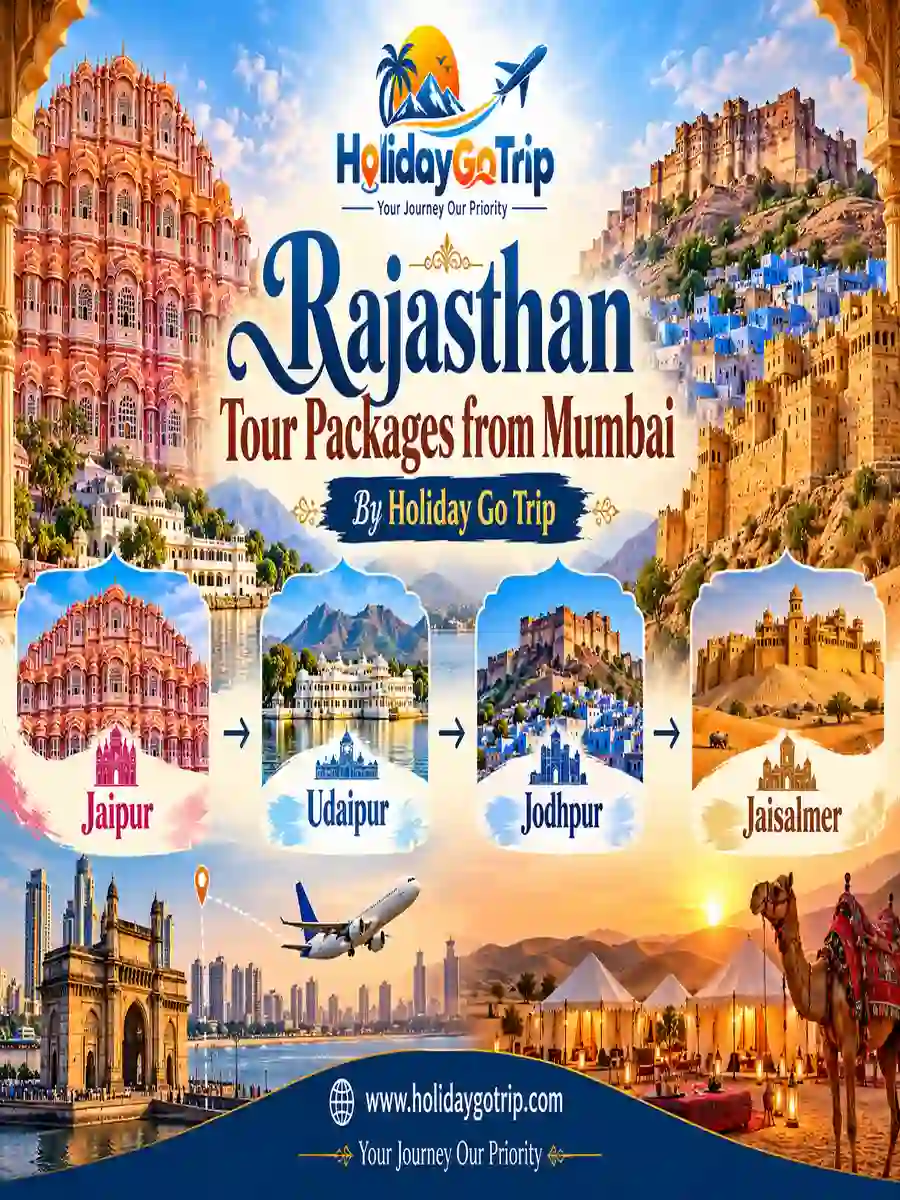
Rajasthan Tour Packages from Mumbai
⌖ Jaipur → Udaipur → Jodhpur → Jaisalmer
Starting fromPrice on Request


Jaipur → Udaipur → Jodhpur → Jaisalmer Desert Camp → Bikaner → Jaipur / Bikaner
Holiday Go Trip's proposed 6 Nights / 7 Days Rajasthan family tour covers Jaipur, Udaipur, Jodhpur, Jaisalmer city and the desert area, followed by Bikaner. The planned stay pattern is one night in Jaipur, two in Udaipur, one in Jodhpur, one in Jaisalmer and one in Bikaner. A private Sedan or SUV can be discussed, along with 3-star, 4-star or 5-star accommodation categories. The package price is Price on Call because the final quotation depends on your dates, group size, room requirements, vehicle choice and confirmed services.
Route at a glance:
Jaipur (1N) → Udaipur (2N) → Jodhpur (1N) → Jaisalmer (city + desert camp 1N) → Bikaner (1N)
Start: Jaipur
Possible end points: Bikaner or Jaipur (return flight/train options discussed at quotation stage)
You fly from Mumbai to Jaipur — roughly 1 hour 40 minutes to 2 hours in the air — and the land journey begins at Jaipur airport. From there, a private vehicle stays with you for the entire Rajasthan leg. You do not change cars in every city, you do not wait for a group bus, and you do not have to wake a sleeping child at 6 a.m. because a shared coach is leaving. On the final day, you either fly out of Bikaner (limited flights) or drive back to Jaipur for a wider choice of return connections. That choice is discussed openly below, because it affects how Day 7 is planned.
The itinerary is built for real family groups — parents with school-age children, multi-generation trips that include grandparents, and couples who want the same route with a quieter pace. Two nights in Udaipur give breathing room after the longer Jaipur–Udaipur transfer. The desert-camp night is kept to one, so the family experiences the dunes without overstaying if younger children find the environment different from a regular hotel. Bikaner adds the red-sandstone forts and the well-known local character that many shorter packages miss.
Why enquire rather than book instantly? Because a genuine family quotation depends on your travel dates, the number of adults and children, children’s ages, room-sharing needs, hotel category, vehicle type, meal plan, and whether you need airport pickup or a specific departure city. “Price on Call” is not a hiding tactic — it is an honest way to avoid quoting a number that may not match your family.
For international families arriving from the USA, UK, Canada, Europe, Australia or Southeast Asia, this route works as a standalone Rajasthan segment inside a longer India trip. The family-specific international notes — kids’ eVisa, car seats, medicines, school-holiday timing — are covered in a separate section below.
| City | Nights |
|---|---|
 Jaipur | 1N |
 Udaipur | 2N |
 Jodhpur | 1N |
 Jaisalmer Desert Camp | 1N |
 Bikaner | 1N |
| Total | 6N / 7D |
WhatsApp +91 78271 61793
Pick-up, drop and itinerary can be changed according to your requirements. You can customise the pick-up point, drop-off point, route, sightseeing, stay and other tour requirements according to your needs.
Important: The information shown on this page is for reference and planning only. It is not a fixed or final package. Final itinerary, availability, services and quotation will be confirmed after discussing your actual travel requirements
Route: Jaipur airport / railway station → hotel → short Jaipur orientation (only if time permits)
 Arrive from Mumbai. A direct flight is typically 1 hour 40 minutes to 2 hours in the air. Airport formalities and the drive into the city are additional.
 Check in and let the children settle. Do not book a timed monument ticket for the same afternoon if your flight lands after lunch.
If you arrive by mid-morning, visit Hawa Mahal from the outside (no long queue, no stairs) and take a short walk through the old city. If the children are tired, skip it. Jaipur’s main sightseeing is not going anywhere.
 Evening: a short market walk or an early dinner. The first day is intentionally light.
 Overnight: Jaipur — 1 night.
Family note: Jaipur airport is close to the city, but the drive can still take 25–40 minutes depending on traffic. Keep a water bottle and a snack in the day bag, not in the checked luggage.
 Breakfast and checkout. Start earlier than you think you need to — this is the longest drive of the trip.
 The Jaipur–Udaipur road journey is commonly planned as 6–8 hours or more, depending on stops, traffic, and the exact hotel location. With children, add at least one proper sit-down break.
 Ajmer and Pushkar are optional, not guaranteed stops. If you leave Jaipur by 8:30 a.m. and the children are comfortable in the car, a short Ajmer stop is possible. If the drive is already slow, skip it. The base itinerary does not depend on it.
Reach Udaipur, check in, and let the evening be free. A short walk near the lake is enough.
Overnight: Udaipur — first night.
Long-drive tip for parents: Pack a separate “car bag” with wipes, a spare set of clothes for younger children, motion-sickness medicine (ask your paediatrician before travel), dry snacks, and a refillable water bottle. Do not rely on highway restaurants for child-friendly food at short notice.
 Route: Local Udaipur sightseeing
City Palace: The complex is beautiful but involves stairs and walking. With young children, choose one or two sections rather than trying to cover every courtyard. With grandparents, use the slower route and take the rest areas seriously.
Lake Pichola: A boat ride is a highlight for children and a comfortable seated activity for seniors. Confirm the boarding point and timing on the day — water levels and operating schedules can change.
 Saheliyon Ki Bari: A garden with fountains and open space. This is often the stop children remember because they can move freely.
 Leave unstructured time. Udaipur’s old lanes and lake viewpoints are better at a slow pace.
Overnight: Udaipur — second night.
What to skip if the family is tired: A second palace museum or a long craft demonstration. One major sight per half-day is a realistic pace for children under 10.
Route: Udaipur → Jodhpur (road) Breakfast and checkout.
The drive is commonly planned as 5–6 hours or more. It is shorter than Day 2 but still a proper road day.
Check in at Jodhpur.
If you arrive with enough daylight, visit Mehrangarh Fort or explore the old blue-city lanes. If arrival is late, move Mehrangarh to the next morning or keep it light — do not force a fort visit after a long drive with tired children.
Evening: local food or a short market walk.
Overnight: Jodhpur — 1 night.
Family note: Mehrangarh involves a climb and a fair amount of walking. If grandparents are in the group, ask the driver about the closest drop point and the lift/elevator access, where available. Do not assume the entire fort is step-free.
Route: Jodhpur → Jaisalmer region → selected desert camp Start early. This is a transfer day plus an evening activity, and the two can collide if you leave late.
The Jodhpur–Jaisalmer drive is commonly planned as 4–5 hours or more, depending on the exact camp location. Camps outside the city add extra transfer time.
 Reach the camp and settle in. Confirm the washroom situation, bedding, and drinking water before the evening activities begin.
If a camel ride or sunset dune visit is included and operating, it usually happens in the late afternoon. Camel rides may have age or health restrictions — check with the camp before booking, especially for very young children, pregnant travellers, or anyone with back problems.
 Cultural programmes are common at camps but are not automatically included in every category. Confirm what your selected camp provides.
 Dinner arrangements depend on the camp category. Confirm whether dinner is included or charged separately.
Overnight: Jaisalmer desert camp — 1 night.
Desert camp reality check for families: A basic camp is not a hotel. If you are travelling with a toddler or a senior who needs a private attached washroom, choose a deluxe or luxury camp category and confirm it in writing. The difference in price is real, but so is the difference in comfort.
Route: Jaisalmer → Bikaner (road) Breakfast and checkout from the camp.
If time permits, a short visit to Jaisalmer Fort or Patwon Ki Haveli before leaving. Do not attempt a full fort tour and a 6-hour drive on the same morning with children.
The Jaisalmer–Bikaner drive is commonly planned as 6–7 hours or more. This is the second-longest drive of the trip. Plan at least one proper break.
Reach Bikaner and check in. The evening is free.
Overnight: Bikaner — 1 night.
Why Bikaner is here: It breaks the return journey and gives children something different — the Karni Mata Temple (Deshnok) with its unique rat population, and the National Research Centre on Camel. These are not “another fort”. They are genuinely memorable for children, and they are easier on grandparents than a second hill fort.
Route: Bikaner sightseeing → Bikaner airport / Jaipur airport or railway station Breakfast and checkout.
Junagarh Fort: A largely flat, manageable fort visit compared with Jaisalmer and Mehrangarh. Good for grandparents and children who are tired of climbing.
National Research Centre on Camel: A short, unusual stop that children tend to enjoy. Confirm opening hours and whether a guide is available.
 Karni Mata Temple, Deshnok: About 30 km from Bikaner. It is a unique experience, but it is not for every family. If anyone in the group is uncomfortable around rats, skip it without guilt.
Departure planning: Bikaner has limited flights. If your return connection is better from Jaipur, the drive from Bikaner to Jaipur is commonly 5–6 hours or more. That makes Day 7 long. If you can, book a late evening flight from Jaipur or add a night in Jaipur. If you are flying out of Bikaner, confirm the flight schedule before finalising the itinerary.
Drop Jaipur / Bikaner Airport or Railway Station.
A realistic warning: Day 7 can become rushed if you plan three Bikaner attractions and a same-day Jaipur departure. For a relaxed family finish, either drop one sightseeing stop or extend the trip by one night.
Private Sedan (Dzire / Etios): Ideal for small families of 2 to 3 passengers with standard luggage. Smooth, economic, and nimble for city sights.
 Private SUV (Ertiga / Innova / Innova Crysta): Recommended for families of 4 to 6 passengers or those carrying extra luggage and child strollers. Features generous legroom, superior suspension, and high seating comfort for highway legs.
 Tempo Traveller (12–16 Seater): Available for larger joint families traveling together.
Mumbai Flight Coordination
Arrive: Mumbai (BOM) → Jaipur (JAI) [Approx. 1h 40m flight]
Depart: Bikaner (PGH) / Jodhpur (JDH) → Mumbai (BOM)
What changes the quotation:
 Travel dates — peak season, Diwali break, Christmas–New Year, and summer holidays are priced differently from off-season.
 Number of adults and children — child pricing depends on age and whether an extra bed is needed.
Room plan — one family room, two rooms, interconnecting rooms, or extra beds.
Hotel category — 3-star, 4-star, or 5-star, and the desert camp category.
Vehicle — Sedan or SUV, and the confirmed luggage capacity.
Meals — breakfast-only vs. breakfast and dinner; child meal charges.
 Sightseeing — monument tickets, guide charges, camel ride, and camp activities.
Flights or trains — only if you ask Holiday Go Trip to arrange them.
 Taxes and payment terms — applicable taxes and the cancellation policy.
What this page will not do: It will not invent a “starting from” price, a fake discount, or a per-person number that changes the moment you add a child. If you are comparing two family packages, compare what is included at the same hotel category, not the headline number.
3-Star Hotel Category
A practical option for families looking for accommodation that fits their budget and sightseeing plans. The facilities, room size, location and meal arrangements vary by property.
4-Star Hotel Category
May suit families looking for additional comfort or a broader range of hotel facilities. The actual amenities depend on the selected property.
5-Star Hotel Category
May be considered by families who prefer a higher-end stay, subject to availability and budget.
Family Room and Occupancy Planning
When requesting a quotation, share the number of adults, children's ages and the number of rooms required. Also mention whether you need separate beds, family rooms or an extra bed.
Room occupancy rules, child charges, breakfast arrangements and extra-bed availability vary by hotel. These details should be checked for the specific properties included in your quotation.
Desert camp note: The Jaisalmer camp is a separate category from the city hotels. A “5-star package” does not automatically mean a 5-star camp unless the camp category is confirmed in the quotation. Basic, deluxe, and luxury camps differ in washroom type, bedding, air-conditioning, and distance from the dunes. Ask for the camp category in writing.
Book the Mumbai–Jaipur flight for the morning.A morning arrival gives you a relaxed afternoon in Jaipur and reduces the chance of a delayed flight pushing the first day into the night.
Do not book a monument ticket for Day 1.
Flight delays happen. If you land late, the ticket is wasted. Keep Day 1 flexible.
 Pack one “car bag” per child.
Wipes, a spare set of clothes, a snack, a water bottle, and any prescribed medicine. Keep it in the cabin, not in the boot.
 Rajasthan is dry, Mumbai is humid.
Children dehydrate faster in dry heat because they do not feel as sweaty. Remind them to drink water even when they say they are not thirsty.
 Ask for mild food at every meal.
Most kitchens can prepare a simple dal, curd rice, or plain roti for children. Do not assume every restaurant has a kids’ menu. Rajasthan’s famous Laal Maas is very spicy — do not offer it to a child who is not used to heat.
 Plan toilet stops before the children ask.
On the Jaipur–Udaipur and Jaisalmer–Bikaner drives, use known highway restaurants or fuel stations with clean washrooms. Do not wait for a “good looking” place when a child needs a stop.
 Sunscreen and hats are not optional.
Even in winter, the Rajasthan sun is strong in the middle of the day. A hat and SPF 50+ sunscreen prevent a grumpy afternoon.
 Carry a basic family medicine kit.
ORS, a thermometer, child-appropriate paracetamol (as advised by your paediatrician), motion-sickness medicine, and any regular prescriptions. Do not assume you will find the exact brand in a small town.
 Confirm the desert camp category in writing.
If you have a toddler or a senior who needs an attached washroom, do not book a “basic” camp and hope for the best. The difference between basic and deluxe is exactly the difference between a shared washroom and a private one.
 Mumbai families with children aged 5–15.
The 6N/7D pace gives enough buffer for one slow morning, one skipped sight, and one unplanned ice-cream stop. The Bikaner night breaks the return drive, which is the single biggest complaint families have on shorter Rajasthan itineraries.
 Multigenerational groups (grandparents + parents + children).
The private vehicle allows different people to do different things. A grandparent can sit out a fort climb and wait in the car or a café. A child can skip a museum and play in a garden. The itinerary does not force everyone to do the same thing at the same speed.
 Couples travelling with a child.
Two nights in Udaipur give you one evening that feels like a holiday for adults, without abandoning the child’s routine entirely.
 International families.
The route works as a Rajasthan segment inside a longer India trip. The international section below covers kids’ eVisa, car seats, medicines, and school-holiday timing — the practical things that generic international guides miss.
Who may prefer a different trip: Families who want a beach or a wildlife safari as the main event. Families with a child under 3 who needs a strict nap and meal schedule may find the two long drive days (Day 2 and Day 6) difficult. In that case, a shorter 5N/6D route or a single-base trip may be more realistic.
This section is written for parents flying into India from the USA, UK, Canada, Europe, Australia, or Southeast Asia. It does not repeat the general international traveller advice you will find on every Rajasthan page. It focuses on the things that change when you are travelling with children. Getting to Rajasthan with children
Most international families fly into Delhi (DEL) or Mumbai (BOM), then take a domestic flight to Jaipur (JAI). If your international flight lands in Mumbai, the Jaipur connection is short — but leave at least 4–5 hours between an international arrival and a domestic departure, especially with children. Immigration, baggage, and terminal changes take longer than you expect.
If you are coming from Southeast Asia, a one-stop connection through Mumbai or Delhi is common. If you are coming from Australia, the journey is longer, so an overnight in your gateway city before the Jaipur flight is often kinder to children. Visa for children
Children need their own visa or eVisa. Do not assume a child can travel on a parent’s visa. Check the official Indian government visa website for the current rules for your nationality, and apply early. Carry printed copies of each child’s eVisa, not just the adults’. The processing time is usually a few working days, but family applications can sometimes take longer during peak travel periods. Car seats and vehicle reality
Do not assume a child car seat is standard in an Indian tourist vehicle. If you need one for a young child, ask specifically at the enquiry stage. Some operators can arrange one; many cannot. If a car seat is non-negotiable for you, confirm it in writing before paying. Medicines and prescriptions
Bring prescription medicines in their original packaging with a copy of the prescription. Carry children’s paracetamol, ORS, and any regular medication in your cabin bag, not checked luggage. Pharmacies in Jaipur and Udaipur are well stocked, but smaller towns may not have the exact brand your child uses. School holidays and peak pricing
Mumbai schools typically break for Diwali, Christmas–New Year, and summer. These are also peak Rajasthan travel periods, and hotel rates rise accordingly. If you are flying in from abroad and your dates are fixed by school holidays, book earlier rather than later. If your dates are flexible, the shoulder weeks just before or after the peak can be better value and less crowded. Food and water for children
Drink sealed bottled water, and use it for brushing teeth if your child is sensitive. Avoid ice in drinks outside reputable restaurants. For food, freshly cooked hot meals are safer than raw salads or cut fruit from street vendors. Most hotels can prepare mild pasta, dal, rice, or curd for children. Do not make the first day a street-food adventure — let everyone adjust first. Cultural etiquette with children
Teach children to greet with “Namaste” and to remove shoes before entering temples. Cover shoulders and knees at religious sites. Ask before photographing people. These small habits make a big difference in how locals respond to your family. Connectivity and emergency numbers
A local SIM or eSIM is useful for maps, cab backups, and staying in touch with the driver. Airtel and Jio have good coverage in the cities on this route. Save the emergency numbers: Police 100, Ambulance 102, Tourist Helpline 1363. Save your embassy’s number in India before you leave home. Tipping and small cash
Keep small denominations for tips and small purchases. A multi-day private driver is usually tipped at the end of the trip, not every day. Hotel porters and housekeeping are tipped separately. Do not rely entirely on cards in smaller towns or at desert camps.
 Age-Wise Pacing Guide (What Actually Works)
The single most useful rule: One “big” sight per day. Everything else is optional. Families who try to do two forts and a museum in one day usually remember the argument, not the architecture.
| Duration | Route | Best for | Trade-off |
|---|---|---|---|
| 5 Nights / 6 Days | Jaipur → Udaipur → Jodhpur → Jaisalmer | Families who want a shorter highlights trip and are comfortable with a faster pace | Less time in each city; no Bikaner |
| 7 Days / 6 Nights | Jaipur → Jodhpur → Jaisalmer → Udaipur → Bikaner | Families who want Bikaner and a slightly more relaxed pace than the 5-night option | Still includes long driving days |
| 8 Nights / 9 Days | Expanded Rajasthan route | Families who want more rest days and deeper sightseeing | Higher cost and longer holiday commitment |
Flight Booking Advice: Choose a morning flight from Mumbai to Jaipur (departing BOM between 6:00 AM and 8:30 AM) so you arrive fresh with a full afternoon ahead. Weather & Clothing: Rajasthan daytime temperatures in winter are pleasant (20°C–28°C), but desert nights in Jaisalmer drop quickly (down to 7°C–10°C). Pack warm jackets, thermals for kids, and comfortable walking shoes for palace cobblestones. Managing Meals for Kids: Rajasthani cuisine can be spicy. Request "low spice" or Jain food preparations at hotel restaurants. Curd rice, plain khichdi, and butter roti are widely available across all stay points.
 Hydration & Dry Air: Coming from humid Mumbai, your family will immediately notice Rajasthan's dry desert air. Keep skin moisturized and ensure everyone drinks plenty of bottled mineral water throughout the day.
 Cash for Local Markets: While UPI and credit cards are accepted at major hotels and shops in Jaipur and Udaipur, carry cash in smaller denominations for desert camel tips, local snacks, and street bazaars.
 Plan Around the Road, Not Only the Sightseeing List
This route includes several substantial transfers. Start times, stops and arrival windows should be agreed in advance.
Traffic, road conditions, weather, meal breaks and hotel locations can change the journey. Keep the first and last days flexible, especially when they connect with flights or trains. Pack a Separate Day Bag
Keep water, snacks, wipes, chargers, a change of clothes, essential medicines and entertainment for children easy to reach.
Store the rest of the luggage securely and confirm that the selected vehicle suits the volume of bags. Think About Walking and Weather
Use comfortable walking shoes and carry sun protection.
Forts, palaces and old-city streets may include stairs, slopes, uneven paving or queues. During hot weather, discuss early starts and breaks. During cooler weather, pack an extra layer for evenings, particularly in the desert. Confirm Room Arrangements in Writing
Do not assume a child stays free, an extra bed is provided or an adjoining room is available.
Share children's ages and ask about the hotel's actual occupancy and child policies. If accessibility matters, confirm the specific property and room rather than relying only on its star category. Choose Jaisalmer Priorities in Advance
With one night in Jaisalmer, choose how much time to give the fort and old city and whether to stay in a city hotel or desert camp.
Ask exactly which activities, meals and transfers are included. Add a night if both detailed city visits and a relaxed camp experience are important to your family. Common Mistakes to Avoid
| Category | What to pack |
|---|---|
| Clothing | Light cottons for daytime, one light jacket or shawl per person for desert evenings, full-sleeve cotton for sun protection |
| Footwear | Closed walking shoes with grip; sandals are fine for the hotel but not for forts |
| Sun protection | SPF 50+ sunscreen, wide-brim hat, sunglasses for children and adults |
| Health kit | ORS sachets, thermometer, child paracetamol (as advised), motion-sickness medicine, regular prescriptions, blister plasters |
| Hygiene | Hand sanitiser, wet wipes, tissues, a small bottle of handwash |
| Documents | Printed tickets, hotel confirmations, ID for each family member, passport copies for international travellers, insurance details |
| Comfort | Reusable water bottles, a light blanket for the car, a small pillow for younger children |
| Tech | Power bank, chargers, a universal adapter if coming from abroad, offline maps |
Bikaner is included — and properly planned. Many 7-day Rajasthan itineraries skip Bikaner or rush through it. This route gives Bikaner its own space, with Junagarh Fort and the camel research centre — two experiences that work well for children and adults alike. Private vehicle throughout. You are not sharing a bus with strangers. Luggage stays with you, stops can be discussed, and the driver is dedicated to your family for the Rajasthan leg.
Family-paced days. Each day includes a Family Comfort Note with walking intensity, suggested rest windows, and practical meal timing. This is especially useful when travelling with young children or senior parents.
Hotel category choice. You can choose 3-star, 4-star or 5-star accommodation. The final hotel names and room types depend on availability and your quotation, but the category choice lets you control comfort and budget.
Senior-friendly planning. Forts involve walking, but the itinerary flags which sections are easier, where lifts or ramps may be available, and when a senior traveller may prefer to rest instead.
Mumbai-friendly start and end. You fly into Jaipur from Mumbai and can fly out from Bikaner or Jaipur. The route avoids a unnecessary return drive to Jaipur if your departure works from Bikaner.
 Clear quotation process. You will know exactly what information is needed, what is included, and what is excluded before you commit.
The two long drives on this route are not a secret. They are the price of covering five destinations in seven days. Here is how families actually manage them:
 Leave early. A 7:30–8:00 a.m. departure gives you buffer for a long lunch and a toilet stop, and still gets you to the hotel before dark.
 Pack car snacks that do not melt. Bananas, biscuits, dry fruit, and sealed juice boxes are easier than chocolate.
 Water for everyone, not just the adults. Keep a bottle within reach of each child.
 Download offline content. Mobile coverage can drop on highway stretches. Download music, audiobooks, or a few episodes before leaving the hotel.
 Car games beat screens for shorter stretches. “Spot the camel”, counting yellow trucks, or a simple atlas game can fill 30 minutes without motion sickness.
 Motion sickness medicine before the drive, not after. If your child is prone to car sickness, ask your paediatrician about timing. Do not wait until the child feels unwell.
 Stop before someone urgently needs it. Use a clean highway restaurant or fuel station. Do not assume the next stop will be better.
Rajasthan is not a difficult place to feed children, but it helps to know what to ask for.
A simple rule for the first two days: Eat cooked, hot, familiar food. Introduce new dishes after everyone has adjusted to the heat and the travel.
The Jaisalmer desert camp is the most memorable night of the trip for many families, and the most uncomfortable for some. The difference is usually the category, not the desert.
What to confirm before booking:
Is the washroom attached and private? Is there air-conditioning or heating, depending on the season? How far is the camp from the main road, and how much walking is involved? Is dinner included, and is there a child-friendly option? Is the camel ride included, and are there age or health restrictions? Is the cultural programme every night, or only on certain days?For seniors: Ask about the walking distance from the vehicle to the tent, and whether the camp has a ground-floor option. Do not assume every camp is step-free.
For young children: Ask about bedding arrangements and whether the camp can provide a simple meal at a child’s usual dinner time, rather than waiting for the group buffet.
A family quotation is not the same as a per-person price multiplied by four. Here is what actually moves the number:
What to ask for: A written quotation that separates accommodation, transport, meals, and extras. A single “package price” without a breakdown is hard to compare and easy to dispute later.
Hawa Mahal, Jaipur — from the street opposite; no entry needed, no stairs. Lake Pichola, Udaipur — from the ghats or a boat; children can move around. Saheliyon Ki Bari, Udaipur — open space, fountains, and room for children to walk. Blue-city lanes, Jodhpur — from a rooftop café or a gentle lane walk; no fort climb Sam Sand Dunes, Jaisalmer — sunset from the dunes; children can run freely. Junagarh Fort courtyard, Bikaner — flatter and easier for grandparents than a hill fort.Rajasthan is well connected to most Indian cities by air, rail and road. The best option depends on your starting point, travel time, budget and the first Rajasthan city on your itinerary.
Jaipur is a practical air gateway for many Rajasthan holidays, especially when the itinerary starts in Jaipur. Udaipur and Jodhpur can also work well when your route is focused on southern or western Rajasthan.
Rajasthan has an extensive railway network, and cities such as Jaipur, Ajmer, Jodhpur, Udaipur, Kota, Bikaner and Bharatpur are useful railway points depending on your itinerary.
Rajasthan has road connections with Delhi NCR, Haryana, Punjab, Uttar Pradesh, Gujarat, Madhya Pradesh and other nearby regions. Depending on the distance, travellers can choose between private cars, taxis and intercity buses.
There is no single "best" way to reach Rajasthan for every traveller. Your first destination should guide the decision.
If you are coming to Rajasthan from the USA, UK, Canada, Europe, Australia, Southeast Asia or another international destination, your first decision is often the Indian gateway airport.
Delhi and Mumbai are commonly useful international entry points. From there, travellers can continue towards Rajasthan by domestic flight, train or private vehicle depending on the itinerary.
There is no single "best" way to reach Rajasthan for every traveller. Your first destination should guide the decision.
Holiday Go Trip can prepare a tour proposal according to the requirements you share, subject to availability and confirmation of services.
Review the final itinerary and quotation carefully so your family knows which destinations, accommodation arrangements, transfers and activities are included in the trip.
Stay options can be discussed according to your destination, travel dates, preferred category and budget.


